
A company can match your target industry, headcount, location and job title—and still be completely wrong for your offer.
Those filters help narrow a market. They do not explain why a company would need you, why now is the right time, or whether your offer fits the way it operates.
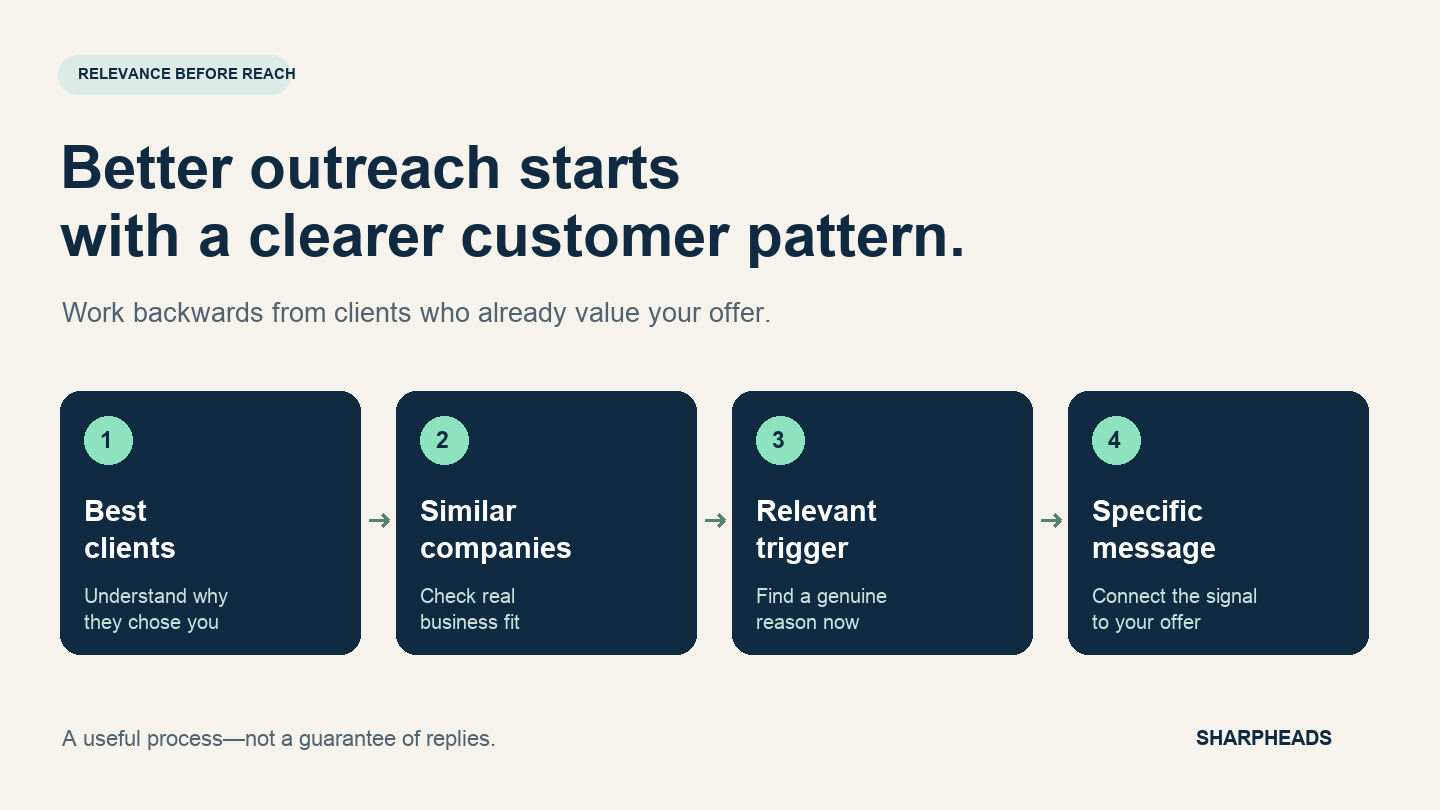
Instead of starting with a larger list, we worked backwards from clients who had already paid us. We looked for the patterns behind those relationships, found similar companies and contacted only the ones with a clear reason for us to reach out.
That is the approach behind the 50+ positive replies I describe in the video below. It is a result from that outreach—not a promised reply rate, a meeting count or a revenue claim.
The useful lesson is the process: start with a proven customer pattern, look for a relevant trigger, then write a message that connects the two.
Watch the short walkthrough
Playing this video connects to YouTube, which may receive your IP address and process data under its own privacy policy.
1. Work backwards from clients who already chose you
Before adding more filters to a prospecting tool, look closely at the clients you would like more of.
For each one, answer four questions:
- What do they sell? Describe the actual product or service, not just the industry label.
- Who do they sell to? Their customers and buying process may matter more than their employee count.
- How does their business work? Look at the business model and how they acquire or serve customers.
- Why did they hire you? Identify the problem, change or priority that made your offer relevant.
You are looking for a pattern you can explain in plain language.
“B2B companies with 20–100 employees” is a starting filter. “A specialist service business trying to build a more consistent sales pipeline” describes a situation you can investigate.
That second description is an illustrative example, not a finding about every business in that category. Your own client evidence should determine the pattern.
If you do not yet have paying clients, treat your starting pattern as a hypothesis. Use customer conversations and early enquiries to test it; do not present it as proven.
2. Find similar companies—and check the resemblance
In the workflow shown in the video, we used our best clients’ domains as the starting point for a company lookalike search.
The point was to find businesses similar in what they actually do, rather than relying only on broad industry tags.
A lookalike result is still a candidate, not a qualified prospect. Before adding a company to your outreach list, check:
- Does it sell a comparable kind of offer?
- Does it serve a similar customer?
- Is its business model relevant to the problem you solve?
- Can you explain why your offer might help it?
If the only resemblance is an industry label, keep looking. A smaller list with a clear reason behind every company is more useful than a large list you cannot explain.
3. Find one genuine reason to reach out now
Fit answers “Why this company?” A trigger helps answer “Why contact it now?”
For the outreach in the video, we checked public signals such as:
- Long-running job openings.
- Founder posts.
- New hires.
- Company news.
We contacted companies where we found a clear reason to reach out.
The important distinction is between what you observed and what you assume it means. A vacancy does not prove that a company is struggling. A new hire does not prove that it has budget for your service.
Use the signal to form a relevant question, not to diagnose a stranger’s business.
For example, if a founder publicly discusses expanding into a new market, you can refer to that expansion. You should not turn it into an unsupported claim that their current sales process is broken.
Before writing, complete this sentence:
I am contacting this company because I observed ___, and our offer may help with ___.
If the connection feels forced, the message is not ready.
4. Connect the trigger to your offer in a short, specific note
Animated highlight of the same four-step outreach process: best clients, similar companies, relevant trigger and specific message. All steps remain readable without animation.
We used ChatGPT to help connect the observed trigger with our offer and draft a short note. We then presented the message as a handwritten-style image and sent it through LinkedIn.
The image was the format. The relevance came from the research.
Each note connected the company, the situation we had identified and the help we could offer. It was not the same generic pitch with a different company name at the top.
You can use this simple structure:
- Observation: mention something specific you actually found.
- Relevance: explain the connection to the work you do.
- Next step: ask one small, clear question.
Here is a fictional example—not a message from the original campaign:
Hi Maya—I saw your post about taking your specialist consulting offer into the US market. We help B2B service teams identify companies that resemble their best clients and build outreach around relevant business signals. Would a short outline of that approach be useful?
AI can help shorten a note or improve its wording. It should not invent the trigger, claim to know a prospect’s internal problems, or imply a relationship that does not exist.
A handwritten-style image should also be described honestly. It is a presentation choice, not evidence that someone physically wrote the note by hand. Keep the message readable and make the core point available as text too.
When this approach makes sense
The workflow is most relevant when you have a defined niche and the people you want to reach are active on LinkedIn.
It is less useful when your audience is too broad, you cannot explain the customer pattern, or your prospects do not use the channel.
You also do not need to copy every part of the format to apply the idea. You can test a concise text message first. Keep the customer fit and trigger; choose a format that suits the conversation.
A practical way to test it
For your next small outreach test:
- Choose a few clients whose problems you understand well.
- Write down the common pattern behind why they hired you.
- Find a small set of companies that plausibly share that pattern.
- Save the public source behind each outreach trigger.
- Review every note before sending it.
- Record replies, positive replies, meetings and eventual customers separately.
Do not count every response as interest. Decide in advance what a positive reply means for your business, and keep the number of messages sent alongside the results.
The video reports more than 50 positive replies, but it does not establish that the handwritten-style image alone caused them. The targeting, timing, offer and message all formed part of the approach.
Start with relevance, then improve the message
Better outreach does not always begin with a clever opening line.
It can begin with a more useful question: What do the clients who already value our work have in common?
Use that answer to find the right companies. Look for a genuine reason to contact them. Then write a note that makes the connection clear.
If you want help building a process like this for your business, talk to SharpHeads.