
Define the motion
Translate your offer, ICP, personas, exclusions, source strategy, and meeting goal into a structured campaign.
SharpHeads uses LeadGen OS to connect campaign strategy, signal-led sourcing, validation, infrastructure, outreach, replies, and memory—then operates that complexity toward qualified, meeting-ready conversations.
Software + implementation + expert guidance
Most teams can send an email. The operational mess happens before and after it: fragmented research, repeated enrichment, scattered exclusions, disconnected copy, invisible decisions, and reply context trapped in inboxes.
Every disconnected tool creates another handoff, another decision point, and another place where quality disappears.
LeadGen OS keeps the context attached as work moves through the system. Human judgment stays visible instead of disappearing inside automation.
Translate your offer, ICP, personas, exclusions, source strategy, and meeting goal into a structured campaign.
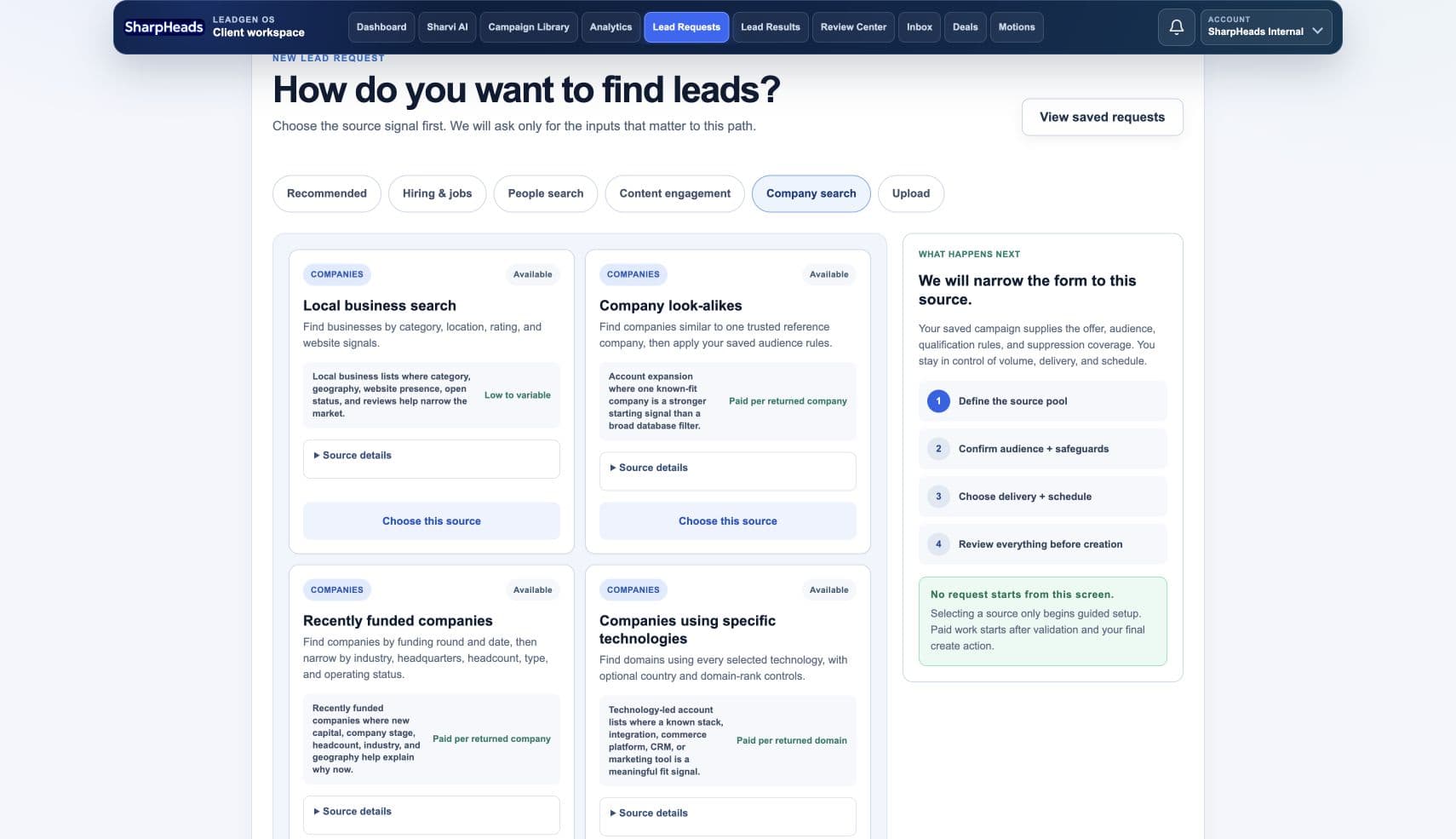
Use hiring activity, profile search, company lists, content engagement, directories, uploads, and configured sources.
Enrich, deduplicate, suppress, validate, and apply human review before a prospect enters outreach.
Connect source context, company fit, contact role, and offer angle so the message reflects why the prospect was found.
Classify replies, preserve context, support response decisions, and move qualified interest toward the calendar.
Companies, contacts, exclusions, source paths, replies, and outcomes stay available to improve the next motion.
These are real product surfaces from an internal SharpHeads workspace. The figures shown are sample workspace data, not customer performance claims.
Choose from hiring activity, people search, content engagement, company discovery, technology detection, funding events, look-alikes, and uploads.
This is a working SharpHeads workspace—not a staged product animation. The recording uses internal sample activity and obscures prospect-level details for the public version.
Direct prospect identifiers are selectively blurred. The surrounding product workflow and sample conversation context remain visible.
LeadGen OS retains the operational history that teams usually rebuild: researched companies, contacts, suppression decisions, source paths, messaging context, replies, and outcomes.
Sharvi analyzes outcomes, helps draft offers and campaign strategies, prepares Lead Requests, and guides the next decision through conversation instead of leaving users alone with another complicated interface.
The application remains the source of truth. The conversational layer brings workspace memory, workflows, and review points into a simpler operating experience while consequential actions remain subject to explicit approval.
Both plans are scoped around TAM, monthly sends, source and signal complexity, infrastructure, motions, and the level of operation SharpHeads carries.
SharpHeads owns the operating work from strategy and signals through validation, outreach, reply triage, optimization, and qualified meeting handoff.
Scope MaxSharpHeads builds the system around your offer and runs beside your team through the first month. Your team then takes over Review Center, replies, sales follow-up, and ongoing operation.
Scope ManagedIt is an implementation-led outbound operating system. Every client gets the software and configuration. Managed is built, launched, and handed over after the first assisted month. Max is operated continuously by SharpHeads.
With Managed, SharpHeads helps during the assisted launch month and then your team owns Review Center decisions, replies, and follow-up. With Max, SharpHeads continues operating those workflows and coordinates meeting handoff.
Source paths can include hiring signals, funding events, tech-stack detection, professional profile search, company-first lists, directories, uploads, job boards, content engagement, social intent, social signals, look-alike logic, and configured provider paths. Availability depends on the motion and provider access.
Funding events, detected technologies, technology changes, and relevant social engagement can give the system a timely reason to research and prioritize an account. They are treated as intent clues—not proof that someone is ready to buy—then combined with ICP fit, role relevance, validation, and the context of the motion.
Yes. Review gates can be placed around lead quality, qualification decisions, message samples, campaign settings, and sensitive operating changes.
Yes. Managed is specifically designed for a complete setup, assisted first month, and handover. Your team keeps workspace access, campaign history, operating assets, and the system memory created during the engagement.
The scope depends on TAM, total sends, signals and providers, infrastructure, research and validation work, number of motions, reply ownership, and the operating load SharpHeads will carry.
There is no universal guarantee because offer maturity, market conditions, volume, sales follow-up, and operating ownership vary. For a qualified engagement, SharpHeads may define a specific performance commitment and remedy in the signed commercial agreement after reviewing the offer, market, scope, and responsibilities.
We will review the context before the call and use the walkthrough to show where LeadGen OS fits, what SharpHeads would operate, and what should remain with your team.